Goethe B2 Schreiben is not graded on how good your German sounds. Here is what examiners actually score.
Most people who fail Goethe B2 Schreiben don't fail because of their German. They fail because nobody told them what examiners really score.
 By Luca Heider
- Goethe B2
- Schreiben
- Exam Prep

Someone takes the Schreiben exam four times. Same city. Same format. Same feeling walking out: "That went pretty well." Scores come back: 55, 56, 55, 55. Each time they're convinced their writing improved. Each time the number barely moves. After the fourth attempt they start wondering whether the exam itself is broken.
It's not. This pattern shows up constantly. People with functional, decent German keep failing the same module while passing the other three. They study harder. Write more. Use fancier words. And nothing changes, because they're optimizing for the wrong thing.
Most people who fail Goethe B2 Schreiben don't fail because their German is bad. They fail because they wrote good German instead of answering the four bullet points the way examiners score them. This post is about what that means and how to fix it.
What examiners actually score (and what they don't)
Schreiben is graded on eight sub-criteria across two tasks. Most candidates have never looked at the breakdown. They assume "write good German" is the goal and leave it at that.
Two of those eight categories carry most of the weight: Aufgabenerfüllung and Kohärenz.
Aufgabenerfüllung means: did you address every content point in the prompt? Each task gives you four specific bullet points to cover. Not themes. Not vibes. Specific points. Examiners go through your text and check whether each one appears. If a point is missing or only vaguely implied, you lose the single biggest scoring category before grammar even gets touched.
Aufgabenerfüllung alone is worth roughly a third of a passing score.
Kohärenz means: does the text hold together? Is there a logical flow? Do you use transitions between paragraphs? Does the greeting match the recipient? Is the sign-off appropriate? Does the register fit the situation (formal email vs. informal forum post)?
Here's what this means in practice. If you cover all four bullet points clearly, use the right opening and closing, and connect your paragraphs with basic transitions, you can pass with B1-level grammar. Not comfortably. But enough.
The flip side matters more. Fancy vocabulary does not compensate for a missing bullet point. You can write the most elegant German the examiner has ever read, and if you skipped one of the four content points, you'll fail Aufgabenerfüllung. The math doesn't recover from that.
Most B2 Schreiben guides online never get this specific. They tell you to "practice writing" or "expand your vocabulary." That advice isn't wrong. It's just beside the point. The exam has a scoring formula. Learn the formula first.
The three mistakes "fluent" people make
These show up again and again. If you've failed Schreiben or you're nervous about your first attempt, see if you recognize yourself.
1. You wrote about the topic instead of the four bullet points.
You read the prompt. You got an idea. You ran with it. Maybe you wrote something interesting, even insightful. But the exam doesn't reward interesting. Examiners aren't reading for pleasure. They're checking whether each bullet point appears in your answer. If one is missing or buried inside a paragraph about something else, you lose the biggest scoring category before anyone looks at your Konjunktiv II.
2. You used C1 vocabulary in a B2 frame and made it worse.
This one hurts because it feels like effort should count. It doesn't. Sophisticated words you don't fully control produce semantic errors that examiners spot instantly. A B2 sentence with the right word beats a C1 sentence with the wrong one every time. On top of that, mismatched register (formal phrases in an informal forum post, casual language in a formal email) costs you Kohärenz points. Simpler is safer.
3. You ignored the email format in Teil 1.
This is the single biggest Schreiben failure mode. Greeting. Opening line. Sign-off. Register matched to the recipient. These are mechanical points, and most candidates leave them on the table entirely. People score in the high 80s on the other three modules and fail Schreiben because they skipped the email frame. It feels trivial. It's not. The rubric treats format as structure, structure feeds into Kohärenz, and Kohärenz is half the game.
The seven-day fix
You don't need a tutor for this. You need the rubric, a timer, and honesty.
Day 1: Read the rubric. Not skim. Read every category and its descriptors. Most candidates have never seen the official scoring grid. It's free on the Goethe-Institut website. Print it if that helps. Understand what each level within each criterion actually describes.
Day 2: Write one Teil 2 forum post under exam conditions. Time yourself. No editing. No dictionary. Pretend it's real.
Day 3: Grade your own text against the rubric. Be honest. Mark which content points you covered and which you skipped or only half-addressed. This step is uncomfortable. It's also the most important one, because most people have never confronted the gap between how their writing feels and how it scores.
Day 4: Memorize 6 to 8 sentence frames. Openers, transitions, and sign-offs for both Teil 1 (formal email) and Teil 2 (forum post). Not entire essays. Frames you can adapt to any topic. Write them out by hand until they're automatic.
Day 5: Write a Teil 1 email under exam conditions. Same drill. Grade yourself afterward using the rubric.
Day 6: Pick the weakest bullet point from both practice texts and rewrite that paragraph three different ways. This is where real improvement happens. Not in the parts you already handle well. In the one paragraph you keep fumbling.
Day 7: Full mock under exam conditions. Both Teile. No breaks. Then walk away. The prep is done.
If you're also preparing for Hören, that module has its own patterns worth studying separately. But fix Schreiben first. It's the module where focused effort converts to points the fastest.
The AI mistake almost everyone makes
Two approaches. Same tool. Completely different outcomes.
One person uses ChatGPT to "make my sentences sound more B2." They paste their text, ask for improvements, memorize the polished version. They keep failing. The model makes their German sound better, but better-sounding German was never the problem. They're still not covering all four bullet points. They're still skipping the email format. They just have prettier sentences that miss the same marks.
Another person does something different. They upload the official Goethe scoring rubric and ask the model to grade their text against it, category by category. Aufgabenerfüllung: did I hit all four points? Kohärenz: is the structure right? Register: does it match? That person scored 94 out of 100.
The rubric is the answer key. Most candidates never give it to the model. They ask AI to improve their German when they should be asking AI to score them the way examiners score them. The difference isn't the tool. It's whether you gave it the right job. Polish is the wrong job. Scoring against the rubric is the right one.
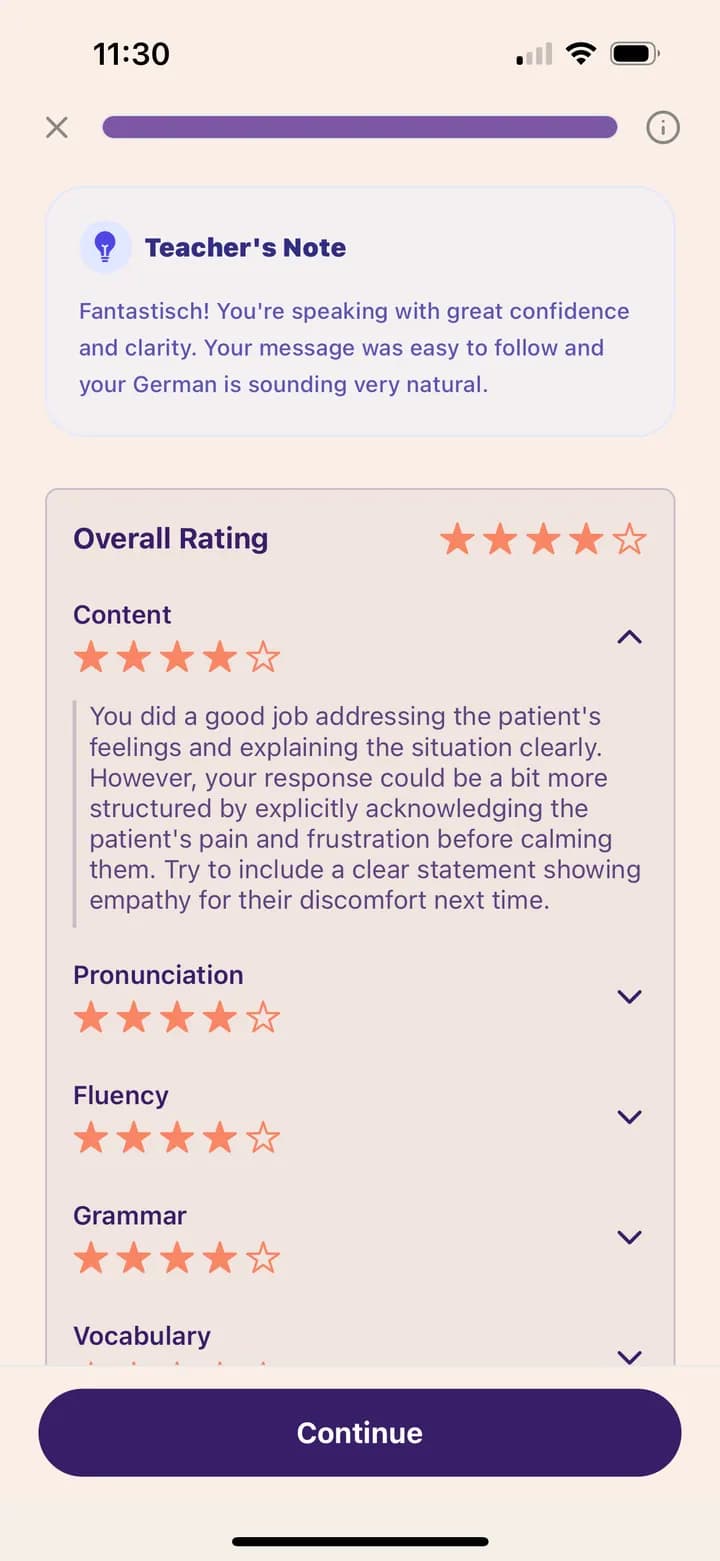
Fluedy's Goethe B2 course is built on the official rubric, so when it grades your Schreiben it scores the same things examiners score (Aufgabenerfüllung, Kohärenz, register, all eight categories) instead of just telling you your German sounds nice.
What to do tomorrow morning
Open the official Goethe B2 Modellsatz. Find the Schreiben section at the end. Read the rubric before you write another word.
Start today
Fluedy is on Google Play and the Apple App Store.